
Menu
Pueblo Concrete Foundation Repair: Cost & Techniques
Concrete Foundation Repair Pueblo
Foundation problems in Pueblo homes demand immediate attention to prevent escalating damage and costly repairs. Understanding available concrete foundation repair methods and their associated costs helps homeowners make informed decisions when addressing structural issues. Pueblo’s expansive clay soil, freeze-thaw cycles, and elevation create unique foundation challenges requiring specialized repair approaches. Early detection and professional intervention minimize expenses while protecting your home’s structural integrity. This comprehensive guide explores common foundation problems, proven repair techniques, and realistic cost expectations for Pueblo homeowners facing foundation concerns.
Common Foundation Problems in Pueblo
Clay soil is the primary cause of many of the residential foundation problems throughout Pueblo due to how much it expands as it becomes wet and contracts as it dries out. These repeated movements can create significant stress upon a foundation, leading to numerous types of cracks, settling, and structural displacements. The expansive clay soils found in various neighborhoods, such as Aberdeen, Belmont, and Mesa Junction, can result in a great deal of the same problems seen in other locations.
Additionally, free-thaw cycles will also contribute to increased foundation stress in Pueblo’s winter months. Once water enters the cracks of a foundation, it will freeze and expand, increasing the width of the existing damage over time. In addition, poor drainage surrounding a home contributes to the continuous moisture present in the soil, which continually feeds the expansive-contractive cycle of the soil. Identifying these common signs of potential problems prior to them becoming serious will help you avoid minor problems turning into costly structural failures requiring expensive repairs.
Average Cost to Repair Residential Foundations in Pueblo
Typically, the average cost of repairing a residential concrete foundation in Pueblo will be anywhere from $2,500 to $15,000, depending on the severity of the problem and what method of repair you choose. Smaller repair jobs that involve sealing a single crack in the foundation can cost anywhere from $300 to $800 for each crack that is sealed, provided the crack is identified early. Jobs that involve either resolving issues with settling or resolving issues with drainage problems will typically cost $4,000 to $8,000. More involved structural repairs that include underpinning or full stabilization of the foundation will typically cost between $10,000 to $25,000 or more.
These prices represent the typical pricing for the region for labor, materials, and the local soil conditions. Additionally, the soil conditions here in our area often require more involved and complex repair techniques than would be used in an area with more stable soils. However, due to the fact that the cost of living in Pueblo is generally lower than in cities such as Denver or Boulder, we are able to offer more competitive pricing for foundation services than would be available in those areas. Understanding these price ranges will help you to plan for the expenses associated with any needed repairs should your foundation begin to fail.
Methods and Pricing for Repairing Cracks
Epoxy Injection
Epoxy injection is a very effective way to seal cracks in a residential foundation that are less than one-eighth inch wide. Epoxy injection is accomplished by placing liquid epoxy resin under pressure into a crack in the foundation, filling the entire length of the crack. After the epoxy has cured (hardened) to the point of forming a solid bond that is stronger than the surrounding concrete, the repair is complete. Typically, epoxy injection will cost between $300 to $800 per crack, depending on the length and depth of the crack.
Epoxy injection is most suitable for hairline cracks that have resulted from either the natural contraction of the concrete as it ages or the normal settling of the foundation. Epoxy injection will effectively stop water from entering the crack and will restore the structural integrity of the foundation. Most residents in the area will find this method to be a cost-effective solution to their needs when they identify foundation cracks early. However, epoxy injection is not a viable option for cracks that are a result of the continued movement of the foundation or the continued pressure of the soil beneath the foundation. We assess the pattern of the cracks to see if epoxy will provide a permanent solution to the problem, or if there are more substantial repairs needed to address the underlying issue.
Crack Stitching
For larger cracks in the foundation greater than one-eighth inch wide, a crack stitching repair is the only practical solution for a permanent fix. A crack stitching repair involves drilling two grooves in both sides of the crack and inserting steel rods through the grooves and tying the rods together with wire mesh. Finally, new concrete is poured over the top of the rods and wire mesh. The cost of a crack stitching repair varies depending on the length of the crack and the location of the crack; however, typically, a crack stitching repair will cost between $1,000 to $3,000 per crack.
A crack stitching repair will address cracks that result from the significant movement of the foundation or the stress on the foundation from the surrounding soil. The steel rod will prevent the crack from expanding further and will distribute the stress of the soil across a wider area. Residents in Pueblo who have experienced significant settling of their homes, and therefore have large cracks in their foundation, will benefit greatly from combining a crack stitching repair with a foundation stabilization repair. A crack stitching repair is a far more invasive repair than epoxy injection; however, a crack stitching repair provides far greater strength for large structural cracks.
Foundation Leveling Options
Mudjacking or Slab Jacking
Mudjacking is a foundation leveling technique that utilizes a cement-based slurry pumped into the voids beneath a sunken concrete slab to raise the slab back to its original elevation. The technician will drill small holes through the slab to allow for the slurry to be pumped in under pressure. The amount of mudjacking required will depend on the number of feet that the slab has sunk and the overall condition of the soil. Mudjacking is a relatively inexpensive method for raising a slab on grade, with costs ranging from $3 to $8 per square foot. Due to the nature of mudjacking, it is one of the fastest methods available for leveling a foundation.
Mudjacking is a good choice for slab-on-grade foundations that have settled a minimum amount. The procedure usually takes one day to complete and minimizes the disruption to the homeowner. However, mudjacking does add a considerable amount of weight to the soil beneath the foundation, which could lead to further settling in Pueblo’s soft clay soils. Therefore, properties that have significant soil-related problems may continue to settle after mudjacking. It is recommended that the property owner address the drainage and soil stability issues before or at the time of mudjacking to ensure long-term success.
Polyurethane Foam Injection
Polyurethane foam injection is another modern alternative to traditional mudjacking. Polyurethane foam is lighter in weight than the slurry used in mudjacking, yet it provides the same lifting capability. The polyurethane foam will fill the voids in the soil beneath the slab, and the small injection holes left in the surface will be virtually invisible. The cost of polyurethane foam injection will vary based on the depth and volume of the foam required, and will range from $5 to $25 per square foot.
Due to the low weight of the foam, it is an excellent choice for the clay soils found in Pueblo, as it adds a minimal amount of weight to the soil. Additionally, the foam will cure in a matter of minutes, and the homeowner can immediately begin using the area again. Many residents in the University Park and Eagleridge neighborhoods have benefited from the fast, clean, and effective leveling provided by polyurethane foam injection. Although the initial cost of polyurethane foam injection is higher than mudjacking, the long-term performance of the product often justifies the added cost of the product and equipment.
Underpinning and Piering Solutions
Steel Pier Installation
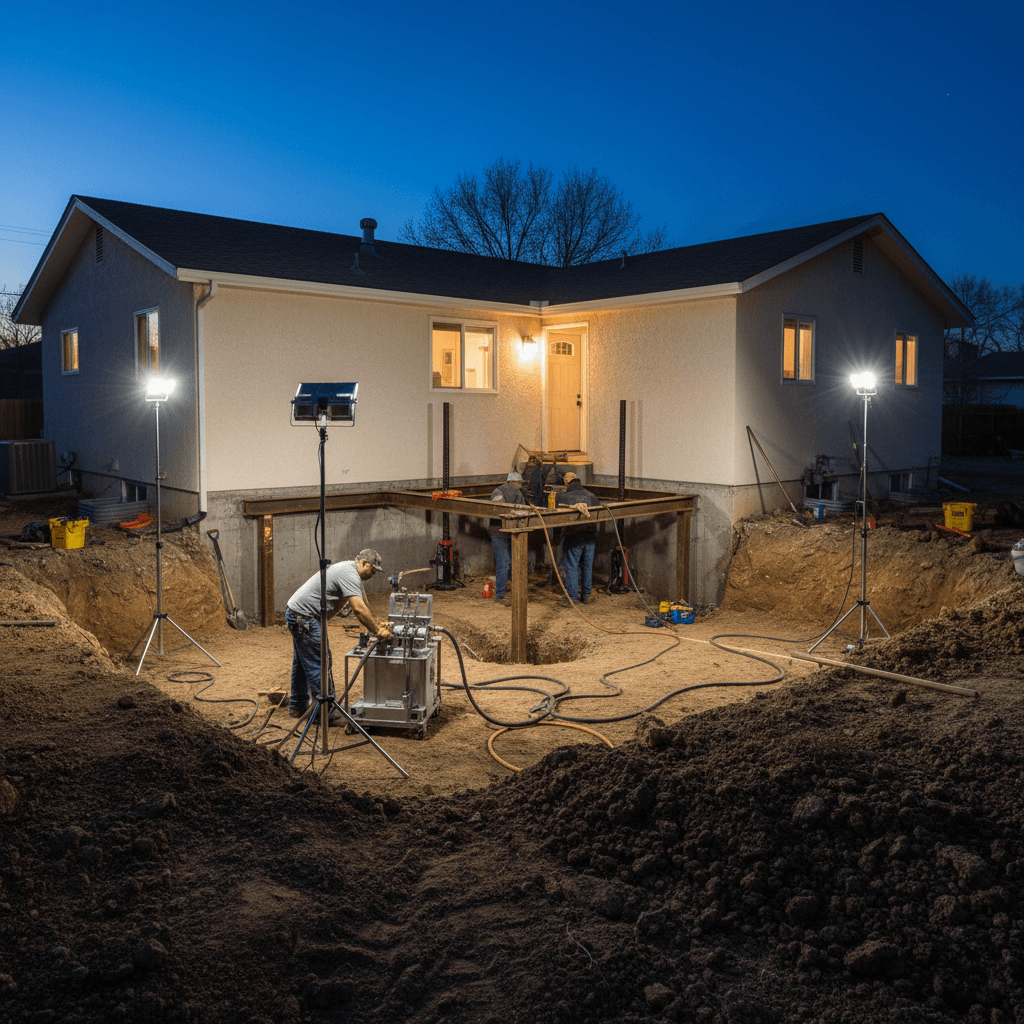
Steel piers provide a permanent foundation support by transferring the weight of the home to a stable layer of soil deep in the earth. To install the steel pier, hydraulic equipment is used to push a steel pipe through the unstable surface soil to reach a layer of rock or a load-bearing layer of soil. The steel pier is then connected to the foundation using a steel bracket. The cost of installing a steel pier is $1,000 to $3,000 per pier. Most homes require 8 to 15 piers to stabilize the structure.
Steel piers provide the most reliable long-term solution for severe settling problems caused by the expansive clay soil found in Pueblo. The piers completely bypass the problematic surface soil and establish support on a stable layer of soil. Homes experiencing ongoing settling problems that were previously addressed through other means will benefit the most from steel piers. The installation of the piers will require heavy equipment and extensive excavation around the perimeter of the foundation. While the cost of steel piers is quite high, the reliability of the piers makes them worth considering for serious foundation problems.
Helical Pier Systems
Helical piers utilize screw-like blades that twist into the ground using hydraulic rotation. The design allows for installation in tighter spaces and creates less ground disturbance than traditional driven piers. The cost of a helical pier system is $1,200 to $3,500 per pier, and includes the cost of the brackets and installation. Depending on the size and type of foundation, most homes require 6 to 12 piers.
Helical piers are an excellent choice for the clay soils found in Pueblo because they cut through the clay soil quickly and easily. Additionally, the installation of helical piers creates little to no vibration and therefore poses no risk to neighboring buildings or utilities. Residents in densely populated neighborhoods such as Belmont or Mesa Junction will appreciate the minimal disruption created by helical pier installations. When compared to steel piers, helical piers offer faster installation and similar load-carrying capabilities. We often recommend helical piers for homes with limited access or when it is desired to minimize landscaping disruption.
Concrete Pressed Pilings
Concrete pressed pilings utilize hydraulic pressure to push precast concrete cylinders deep into the soil beneath the foundation. The multiple concrete cylinders stacked on top of each other reach the stable soil layers below the foundation. The weight of the home itself supplies the driving force through hydraulic jacks. The cost of a concrete pressed pile is $800 to $2,500 per pier, and offers a cost-effective underpinning solution.
Concrete pressed pilings are an excellent choice for the clay soils found in Pueblo because the clay soils provide good lateral resistance. The installation of concrete pressed pilings will require some excavation around the perimeter of the foundation, but will produce long-lasting and strong support for the foundation. Residents in Pueblo who have significant settling issues with their foundations will benefit from the long-term performance record of concrete pilings. The technique has been successful for decades in supporting foundations.
Wall Repair and Reinforcement
Wall Anchor Systems
Properties with bowed or leaning foundation walls will benefit from the use of wall anchors. The wall anchor system consists of a series of steel rods anchored to the exterior of the wall and extending down to the foundation footing. When tension is applied to the rods, the wall is pulled back towards its original position. The cost of a wall anchor system will vary depending on the number of anchors required; however, typically, a wall anchor system will cost between $400 to $800 per anchor. Walls typically require 4 to 8 anchors to properly stabilize.
A wall anchor system addresses the lateral soil pressure against the exterior of the basement walls that causes the walls to bow inward. The expansive clay soils found in Pueblo create significant lateral pressures during periods of high moisture. Wall anchors counteract the lateral pressures while slowly straightening out the bowed section of the wall. Residents in Pueblo with basement foundations located in areas such as Northside or Country Club will often experience bowed walls. A wall anchor system will prevent the wall from collapsing while restoring the structural integrity of the wall, all without the need to replace the entire wall.
Carbon Fiber Reinforcement
Carbon fiber straps bonded to the foundation wall will provide additional support and prevent further bowing of the wall while reinforcing the damaged area. The high-strength fabric is bonded to the wall using an epoxy resin, creating a composite reinforcement. The cost of carbon fiber repair will vary based on the length of the wall that needs to be reinforced; however, typically, a carbon fiber repair will cost between $300 to $600 per linear foot of wall.
One of the benefits of carbon fiber reinforcement is that it does not require excavation and does not disrupt the basement space. Carbon fiber is extremely strong in terms of tensile strength, even though it is thin. Many residents in Pueblo appreciate the lack of disruption caused by carbon fiber repair when compared to more traditional forms of wall repair. However, carbon fiber reinforcement will not correct any existing bowing in the wall, only prevent further bowing. Before recommending carbon fiber reinforcement, we thoroughly evaluate the degree of deflection of the wall to determine if carbon fiber reinforcement will adequately reinforce the wall or if a more aggressive approach is needed to resolve the problem.
Drainage and Waterproofing
Drainage is critical around foundations to prevent future issues. French drain prices vary by length of perimeter and depth and can range from $2,000 to $5,000. The French drain works by draining water before it gets to the foundation and redirects the water away from the house. Interior drainage systems using a sump pump will range from $3,000 to $8,000, including excavation and installation.
Waterproofing foundation walls can be an exterior or interior process. Exterior waterproofing can be applied and ranges in price from $2,000 to $6,000. Interior sealants are more expensive and can cost anywhere from $1,500 to $4,000. Exterior waterproofing is going to provide more protection than interior waterproofing because it is done outside, where water is trying to enter the home. Most properties in Pueblo that have high water tables or poor natural drainage would greatly benefit from a full waterproofing system. Waterproofing and drainage can also be completed together to solve both the cause and the symptom of a foundation issue.
Fundamental Factors that Influence the Cost of Foundation Repair
Type of Foundation
Basement foundations are typically going to be more expensive to repair than slab-on-grade or crawlspace foundations. This is primarily due to the fact that basement foundations require excavation to get to the foundation, which requires more labor. Basements are going to be approximately 20% to 30% higher in cost than slab-on-grade or crawlspace foundations. Crawlspace foundations may fall somewhere in between, depending on how much of the crawl space is accessible.
As you travel throughout Pueblo, you will find a variety of different types of foundations in each area of town based on the age of the homes and the construction methods used. Typically, older homes in Mesa Junction will have basements, while newer homes in Eagleridge will use slab-on-grade. Your foundation type plays a role in whether you are likely to have a problem with your foundation and what method is best suited to correct those problems. We assess your specific foundation to give you an accurate estimate of the cost to repair your foundation.
Severity of Problem
It is significantly cheaper to address foundation problems when they first occur rather than allowing them to go unaddressed until they become more severe. For example, if you identify a small crack in your foundation early in the course of the cracking process, you may be able to have it repaired for approximately $500. On the other hand, if you allow the cracking to continue to the point where the foundation has shifted, and you need to perform a more extensive structural repair (such as underpinning), this could cost upwards of $5,000. The extent to which the cost to repair a foundation increases as the severity of the problem increases, regardless of the method used to repair the problem.
Inspecting your foundation regularly will allow you to identify potential problems early in the process. While it is not always easy to determine the extent of the damage caused by a foundation problem based on visual inspection alone, early identification of a problem will allow you to take corrective action sooner, thereby reducing the overall cost of repair. It is recommended that property owners in Pueblo inspect their foundations professionally every few years, especially after significant weather events. The cost of the inspection will pay for itself many times over through early detection of problems. We encourage our customers to inspect their foundations proactively rather than waiting for signs of damage to develop.
Size and Accessibility of Home
Generally speaking, larger homes require more materials and labor to repair and, therefore, cost more money to repair than smaller homes. As a general rule, A 1,500 square foot home may require 8 piers to stabilize the foundation, whereas a 3,000 square foot home may require 16 piers to achieve the same level of stability, thus doubling the cost of repair. Additionally, the accessibility of your home can also impact the cost of repairs. Homes that are located in areas with limited site access may require the use of smaller equipment or manual labor to complete the repair, increasing the cost of labor and extending the duration of the project.
Additionally, removing and replacing landscaping around the foundation of a home can increase the overall cost of repairs by $1,000 to $5,000. Hardscape, utility lines, and dense plantings near foundations can all create barriers to accessing the damaged area and limit options for repairing the foundation. Due to the above-mentioned reasons, homes in developed neighborhoods such as Belmont or Heritage with mature landscaping may incur the additional costs associated with landscaping removal and replacement. We attempt to limit the amount of landscaping removed during the course of repairs; however, we cannot always avoid impacting landscaping when completing repairs to the foundation.
Indicators for Professional Assessment
If you notice any of the following signs of foundation distress, you should contact a professional immediately:
- Horizontal cracks greater than 1/4 inch in width in the foundation walls or floors. Horizontal cracks are indicative of horizontal structural forces acting upon the foundation.
- Doors and windows that stick or do not open or close properly.
- Gaps are developing between walls, ceilings, or floors.
- Settling of floors, creating uneven or sloping surfaces.
- Evidence of water entering the basement or evidence of past water entering the basement.
Any property throughout Pueblo displaying any of these indicators should have a professional inspection performed as soon as possible. Waiting to perform an inspection will allow the condition to deteriorate further, thereby increasing the final cost to repair the foundation.
Selecting the Right Repair Technique
Selecting the right repair technique for your foundation problem is contingent upon understanding the nature of the problem and the underlying causes of the problem. Addressing surface manifestations of foundation problems, i.e., applying surface treatments to repair cracks, does nothing to resolve the underlying problems. On the other hand, performing structural repairs to the foundation, such as installing piers, will resolve the problem but will generally cost more to install. The correct balance between initial cost and long-term performance-durability of the repair will depend on several factors, including soil conditions, the severity of the problem, and the monetary value of the home.
There is no single “right” way to repair every foundation problem, and there are no standard repair techniques that fit every situation. Each situation must be evaluated individually to determine the most suitable and cost-effective repair solution. We conduct individual evaluations of your property and all relevant factors to provide recommendations for the most effective repair solution available.
Timing & Seasonal Considerations for Foundation Repairs
The spring and summer months represent the best time to schedule foundation repairs in Pueblo. The dry soil provides better access to equipment and facilitates more efficient repairs. Performing repairs in the winter months can be problematic due to the frozen soil, making excavation and labor more difficult and expensive. Serious problems should not be allowed to continue as the damage accumulates rapidly. Scheduling repairs during dry periods will result in better outcomes and often lower costs. If emergency repairs are needed due to structural concerns, we will work year-round to address these situations. We recommend that customers plan for repairs to be performed during the best season for repairs when feasible.
Preserving your Foundation from Future Damage
The most important thing you can do to protect your home’s foundation from damage is to ensure that the surrounding drainage is maintained properly. Gutters and downspouts should direct water at least 6′ away from the foundation. The grading of the yard should slope away from the home to ensure that water does not accumulate around the foundation. Maintaining your gutters, downspouts, and grading will be significantly less costly than repairing damage caused by poor drainage.
Consistently maintaining the moisture levels in the soil beneath your home will help to eliminate the extreme expansion-contraction cycles that can damage your home’s foundation. We recommend that homeowners in Pueblo implement some form of preventative measure to manage the moisture levels in the soil beneath their homes. We will provide you with advice on preventative measures that are suitable for your specific property and foundation type.
Making an Educated Decision on How to Repair Your Foundation
Knowing how much a foundation repair costs and the methods of repair will empower homeowners to make educated decisions regarding how to repair their foundation when problems occur. Detecting and addressing foundation problems early will help minimize costs and reduce the risk of significant structural damage. A professional assessment will help determine the most cost-effective and practical repair method for your specific situation. Protecting your investment in your home and ensuring that your home remains safe and stable are two reasons why selecting the most suitable repair method for your foundation is so important.
Each location throughout Pueblo presents unique foundation challenges that require a combination of expertise and experience working within local soils and weather conditions. At Pueblo Concrete Services, we offer a wide array of services that include concrete foundation repair solutions designed specifically to meet the unique challenges of the Pueblo area and are committed to providing transparent pricing and utilizing proven repair methods to assist homeowners in resolving foundation problems while protecting their investments for decades to come.
LATEST POSTS