
Menu
Pueblo Commercial Concrete: Permits, Regulations & Inspections
Commercial Concrete Pueblo
Navigating regulatory requirements represents one of the most crucial yet often underestimated aspects of commercial construction projects. Pueblo’s building codes and permitting processes exist to ensure structural safety, public welfare, and long-term building performance throughout our community. Business owners and developers who understand these requirements from project inception avoid costly delays, rework, and compliance issues that jeopardize timelines and budgets. Whether constructing a new retail center downtown or expanding an existing warehouse facility, proper attention to permits and inspections protects investments while demonstrating commitment to community standards and safety.
Understanding the Pueblo Regional Building Department
The Pueblo Regional Building Department is the primary building enforcement agency for commercial building projects in much of Pueblo County and the City of Pueblo. The department is located at 830 North Main Street and provides services including reviewing permit applications, processing plans, conducting inspections, and enforcing the adopted building codes. The department generally has jurisdiction over all commercial building projects in Pueblo County; however, there may be other agencies with jurisdiction over particular areas depending on the location of the project. The department is open to the public from 7:30 a.m. to 4:30 p.m., Monday through Friday. The department’s mission is to enforce the building codes and provide a level playing field for all construction projects to ensure they are built safely, efficiently, and economically.
New Initiatives Through Pueblo Means Business
Through Pueblo Means Business, there have been recent initiatives that have improved the coordination among the various government agencies in Pueblo County. Specifically, the county, city, and Pueblo West Metro District have worked together to streamline the coordination of development projects. This effort has made it easier for businesses to develop their projects, as it eliminates the need for businesses to go to multiple agencies to obtain the necessary permits. Previously, businesses had to deal with separate jurisdictions (county, city, etc.) to obtain the permits needed to build their projects. While the process was not always difficult, it was certainly confusing and frustrating at times. For example, businesses that want to develop along the Northern Avenue Corridor will now have a clearer understanding of what permits they will need and how long it will take to get them. Overall, this new initiative will save both businesses and governments money, time, and frustration.
Permitting Commercial Concrete Projects
As stated above, almost all commercial concrete work requires a building permit unless specifically exempted by the building codes. A building permit is required for the construction of any new commercial building, addition to an existing commercial building, and for major repairs to a commercial building. The basic premise is that if you are going to perform any work that affects the structural integrity of the building, the safety of people inside the building, or the means of exiting the building, then you will need a building permit.
There are two main types of commercial permits that you will need to obtain when performing a commercial concrete project: a foundation permit and a structural permit. A foundation permit is required for the excavation, footings, foundation walls, and grade beams that support the structure. To obtain a foundation permit, you will need to submit engineering drawings that include the following information:
- Soil conditions;
- Bearing capacity of the soil;
- Reinforcement specification;
- Waterproofing details.
A structural permit is required for the above-grade concrete elements of the building, including columns, beams, slabs, and walls. When obtaining a structural permit, you will also need to submit engineering drawings that describe the type of concrete being used, its strength, and the number and size of bars that will be used.
When building within the city right-of-way, you will need to obtain a permit from the Public Works Department in addition to the building permit from the Pueblo Regional Building Department. If you are building within a flood zone or in an area where utilities need to be installed, you will need to contact the Pueblo Regional Building Department to determine what other permits you will need to obtain.
Special Permits for Unique Applications
While there are two main types of commercial permits that you will need to obtain, there are some special circumstances where you will need to obtain additional permits. There are several special permits that you may need to obtain in addition to the standard building permit. Some examples include:
- A demolition permit is required for the removal of any portion of a building. The cost of a demolition permit varies depending on the size of the building being demolished and its proximity to other property lines.
- A grading permit is required for any project that involves the movement of a significant amount of earth. This includes, but is not limited to, excavating a basement or building a retaining wall.
- A flood zone permit is required for any project located in a flood zone. This permit ensures that the project meets the standards set forth by FEMA.
The Permit Application Process
The application process for a building permit is relatively straightforward. First, you will need to gather all of the required documents and information and have them ready prior to submitting your application. This will help to ensure that your application is processed promptly. The following items should be included in your application:
- Complete set of construction drawings that meet the requirements of the building codes. All drawings should be signed and sealed by a licensed professional engineer. The drawings should include:
- Dimensions of the building;
- Number and size of bars to be used in the building;
- Type and strength of the concrete to be used in the building;
- Connection details;
- Elevation of the building;
- Location of the building on the property;
- Setbacks and easements;
- Utility connections;
- Access route;
- Site plan that shows:
- The location of the building on the property;
- The setback distances to surrounding buildings;
- Easements and encroachments;
- Access route;
- Utility connections;
- Structural calculations that demonstrate:
- Adequate design to withstand the loads expected to be placed on the building;
- Compliance with seismic design requirements;
- Environmental considerations such as wind, rain, and snow loads.
If any item is missing from your application, it will be rejected, and you will have to resubmit the application. Once your application is accepted, the Pueblo Regional Building Department will assign an inspector to inspect the site and ensure compliance with the approved plans. After the inspection, the inspector will issue a permit allowing you to proceed with your project.
Online Submission of Plans
In addition to making the application process easier, the Pueblo Regional Building Department has also implemented an online plan review portal. Using the Commercial Plan Review Portal, you can upload your plans electronically and track the status of your application. This eliminates the need for paper plans and reduces the time it takes to process your application. Once you have uploaded your plans, you will be able to communicate electronically with your assigned reviewer. This allows you to ask questions and resolve any issues that arise in real-time.
Plan Review Timeline
Once the Pueblo Regional Building Department receives your application and the associated plans, the next step is to review them for compliance with the building codes. Depending on the scope of your project, the review time can vary greatly. Small projects that involve minimal engineering can be reviewed and issued in just a few days. Larger projects that require more engineering and coordination with other agencies can take longer to review. It is possible that the review time may exceed 30 days. Therefore, it is best to allow at least 2 months for review of your plans.
Inspections
In addition to plan review, the Pueblo Regional Building Department will also require inspections of your project at specific stages of construction. These inspections are to ensure that the work being done complies with the approved plans and building codes. Failure to comply can result in fines, penalties, and potential litigation. The types of inspections that will be required depend on the nature of your project. However, most projects will require foundation, under-slab, structural, and final inspections.
Foundation Inspection
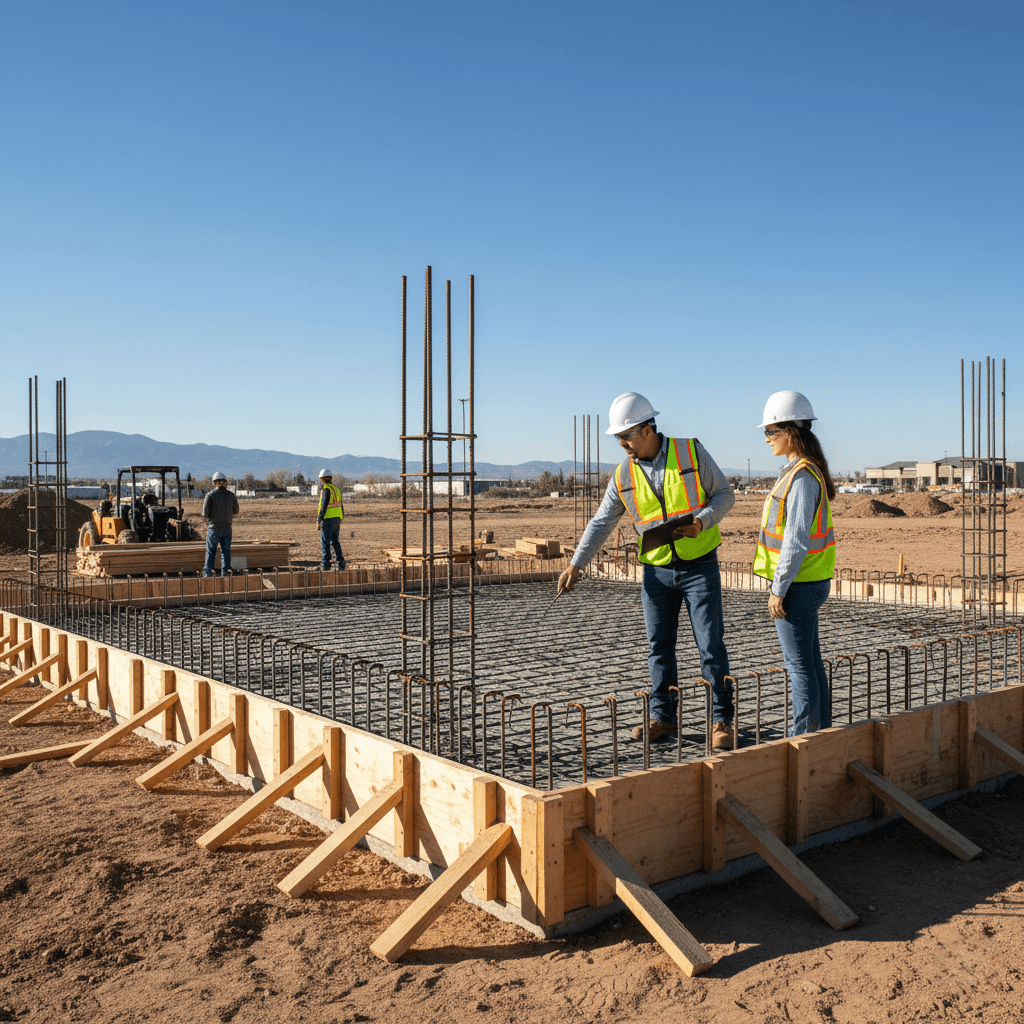
The foundation inspection occurs after the excavation reaches the designed depth but before placing concrete. The purpose of this inspection is to verify that the soil conditions at the job site meet the assumptions contained in the engineering report, that the forms have been installed correctly, and that the reinforcement has been placed correctly. Deficiencies found in the foundation can lead to expensive repair work or even the need to rebuild the foundation.
Under-Slab Inspection
The under-slab inspection is conducted after the substrate has been prepared for concrete placement. This inspection is to verify that the surface is clean, dry, and free of debris and obstructions. Additionally, this inspection will verify that the vapor barrier is in place, that the utilities have been installed, and that the reinforcement is correctly positioned.
Structural Inspection
The structural inspection is conducted after the placement of the slab and the completion of the framework. This inspection is to verify that the reinforcement has been placed correctly, that the concrete meets the specified strength, and that the framing members are correctly sized and connected. Deficiencies found in the structural elements can lead to failure of the building.
Final Inspection
The final inspection is conducted after the completion of all work, including electrical, plumbing, HVAC, and finish work. At this point, the inspector will verify that the building meets the approved plans and that all work has been completed correctly.
Testing and Quality Control Requirements
All commercial concrete projects are required to have materials testing performed to ensure that the concrete meets the specified strength and performance characteristics. The Pueblo Regional Building Department has identified the following tests as required:
- Compression testing of test cylinders at 7 days and 28 days;
- Slump testing to ensure that the concrete is of the correct consistency.
- Air content testing to ensure that the concrete contains enough air to prevent free-thaw damage;
- Temperature monitoring during hot or cold weather to ensure that the concrete is placed within acceptable temperature ranges.
These tests are required to be performed by a licensed testing laboratory, and the results must be provided to the Pueblo Regional Building Department as part of the quality control process.
Building Codes and Standards
The Pueblo Regional Building Department enforces the International Building Code with amendments adopted by Pueblo County. The International Building Code sets minimum requirements for concrete strength, reinforcement, and cover, as well as curing procedures based on building use and exposure conditions. The seismic design provisions of the International Building Code address the risk of earthquakes due to the geology of Colorado. The wind load provisions of the International Building Code address the strong winds that blow across the plains approaching the Front Range.
The International Building Code addresses fire-resistance ratings of concrete elements based on the type of occupancy of the building. The building codes also require compliance with Americans with Disabilities Act (ADA) requirements.
ADA Compliance in Concrete Work
The ADA has a number of requirements that apply to concrete work. The most notable requirement is that all concrete ramps, walks, and curb runs must meet the ADA standards. These standards include requirements for slope, width, cross-slope, transition, and handrail configuration. The Pueblo Regional Building Department will verify compliance with the ADA standards during the final inspection of the project. Any deficiencies found during the final inspection must be correctedbeforeo issuing a certificate of occupancy.
Common Errors in Permit Submissions
Several common errors can delay the processing of a permit application. These include:
- Incomplete drawings that lack critical details;
- Missing engineering seals from licensed professionals;
- Outdated or incorrect code references in plans;
- Survey errors that show incorrect setbacks or easements;
Missing any one of the following items can delay the processing of a permit application:
- Geotechnical report;
- Utility coordination;
- Stormwater management plan.
Each error can delay the processing of the permit application and may require additional expenses to correct the deficiency.
Requirements for Working with Licensed Contractors
In Colorado, all commercial concrete work must be performed by a licensed contractor who possesses adequate insurance and bonding. Licensing of contractors protects property owners from poor-quality construction and ensures that contractors have a proven ability to perform the work. Prior to hiring a contractor, you should verify that they possess the necessary license(s) and insurance coverage. You should also verify that they are bonded to protect you financially in the event that they fail to complete the work.
Responsibilities of Contractors During Permitting
Licensing contractors have several responsibilities during the permitting process. These include:
- Maintaining current licenses;
- Submitting accurate permit applications;
- Scheduling required inspections;
- Coordinating with building officials and addressing any issues that arise during construction;
- Providing documentation, including material certifications, test results, and manufacturer specifications, to demonstrate compliance with approved plans;
- Keeping approved plans available on-site for inspector reference; and
- Ensuring that the work is performed in accordance with the approved plans.
Penalties for Non-Compliance
Failure to comply with the regulations of the Pueblo Regional Building Department can result in serious penalties. These penalties include:
- Stop-work orders;
- Double or triple the original permit fee for unauthorized work;
- Potential loss of property rights due to improper construction;
- Increased risk of accidents;
- Potential for costly renovations or demolitions;
- Difficulty in selling or financing a property due to permit issues; and
- Liability for injuries suffered by workers on-site.
In conclusion, compliance with the regulations of the Pueblo Regional Building Department is essential to avoid the serious penalties associated with non-compliance.
Navigating Commercial Projects Successfully
Commercial project success is directly tied to the degree of engagement with building departments before a project’s designs are finalized. The preapplication process will allow for an understanding of all local jurisdictions’ requirements; provide an opportunity to identify potential issues prior to spending large sums of money on engineering design; and provide a realistic timeline of when a project can be completed. If this information is obtained early in the project, it is possible to avoid the costly redesign that occurs after a significant amount of money has been invested in engineering design. Additionally, professional design teams experienced with the permitting process in Pueblo will be able to quickly address and comply with the various jurisdictions’ requirements and minimize delays to inexperienced applicants.
Commercial project planning should account for the timing associated with obtaining permits and conducting inspections instead of considering these aspects of the project as afterthoughts. Schedules should include sufficient time for plan review, responding to comments from the review authority, and scheduling inspections during the construction phase so that they do not occur at a faster rate than approval can be obtained. Contractors with knowledge of the process should be able to maintain a steady flow of activity in their projects by timely scheduling inspections and completing construction activities in a sequence that does not outpace the ability to obtain necessary approvals. For commercial projects, each day of delay results in additional carrying costs and lost revenue due to delayed occupancy.
Regulatory Compliance Assistance
The permitting and inspection process associated with complex commercial projects can greatly benefit from contractors with a high level of familiarity with the regulatory landscape and good working relationships with the building department staff. The knowledge and experience we have gained in the permitting and inspection process in Pueblo will enable us to streamline the project approval process, while still providing assurance that all applicable regulations are being met. We will coordinate with engineers, architects, and building officials from the commencement of your project until the date of final occupancy to ensure that no unexpected issues arise that may impact your project’s budget or schedule.
As part of our comprehensive approach to commercial projects, we will thoroughly develop a project plan to ensure that all documents submitted with the permit application are complete and compliant with the current codes and regulations. As a result, we will be able to schedule inspections in such a manner as to allow for continuous progress of the construction activities without compromising quality and safety. From the initial site preparation to the final inspection, Pueblo Concrete Services will deliver successful commercial concrete installations that meet the expectations of our clients and the regulatory mandates of our community, providing a solid foundation upon which our clients can build successful businesses.
LATEST POSTS