
Menu
Pueblo Residential Concrete Walkways: Design Guide
Concrete Walkway Pueblo
Creating a concrete walkway that combines beauty with practicality transforms your Pueblo home’s outdoor space while enhancing curb appeal and property value. The right design balances aesthetic considerations with functional requirements specific to our regional climate and soil conditions. Pueblo’s unique weather patterns, expansive clay soil, and southwestern architectural styles influence design choices that ensure long-lasting, attractive walkways. Understanding dimension standards, material options, and decorative techniques helps homeowners create inviting paths that withstand local conditions. This comprehensive guide explores essential design elements for concrete walkways that serve Pueblo homes beautifully for decades.
Essential Walkway Dimensions
Main walkways leading to the front door should be at least 48 inches wide: Two people walk abreast and pass each other comfortably. There’s room for a man with a wheelchair, strollers can be maneuvered around garden furniture being moved, and the passage with furniture-bound loads conforms to code. Another set of walkways leading us from one end of our property to another may be a minimum of 36 inches wide. Prosper Park and Mallard Homes benefit from these ample proportions.
Length is determined by the distance from the street to the entrance, or from one landscape feature to another. The thickness of a walkway? Requirements call for a 4-inch thickness of concrete to support foot traffic alone, but we prefer that it be from 5 to 6 inches wherever wheeled vehicles of considerable mass and weight might occasionally cross over it. Satisfactory dimensions will give you a concrete walkway that will carry its load to the end of the driveway and take the traffic load off Pueblo streets.
Decorative Finish
Stamped Concrete Produce Patterns
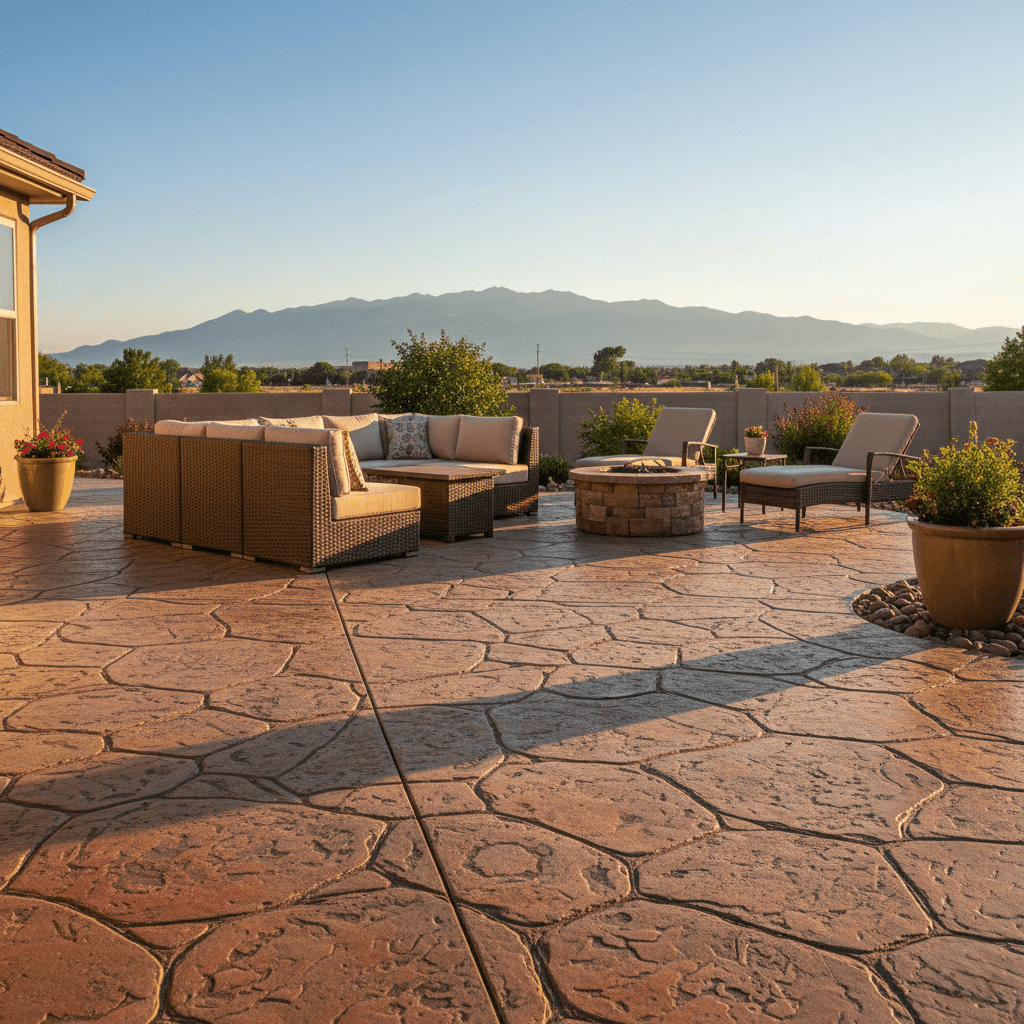
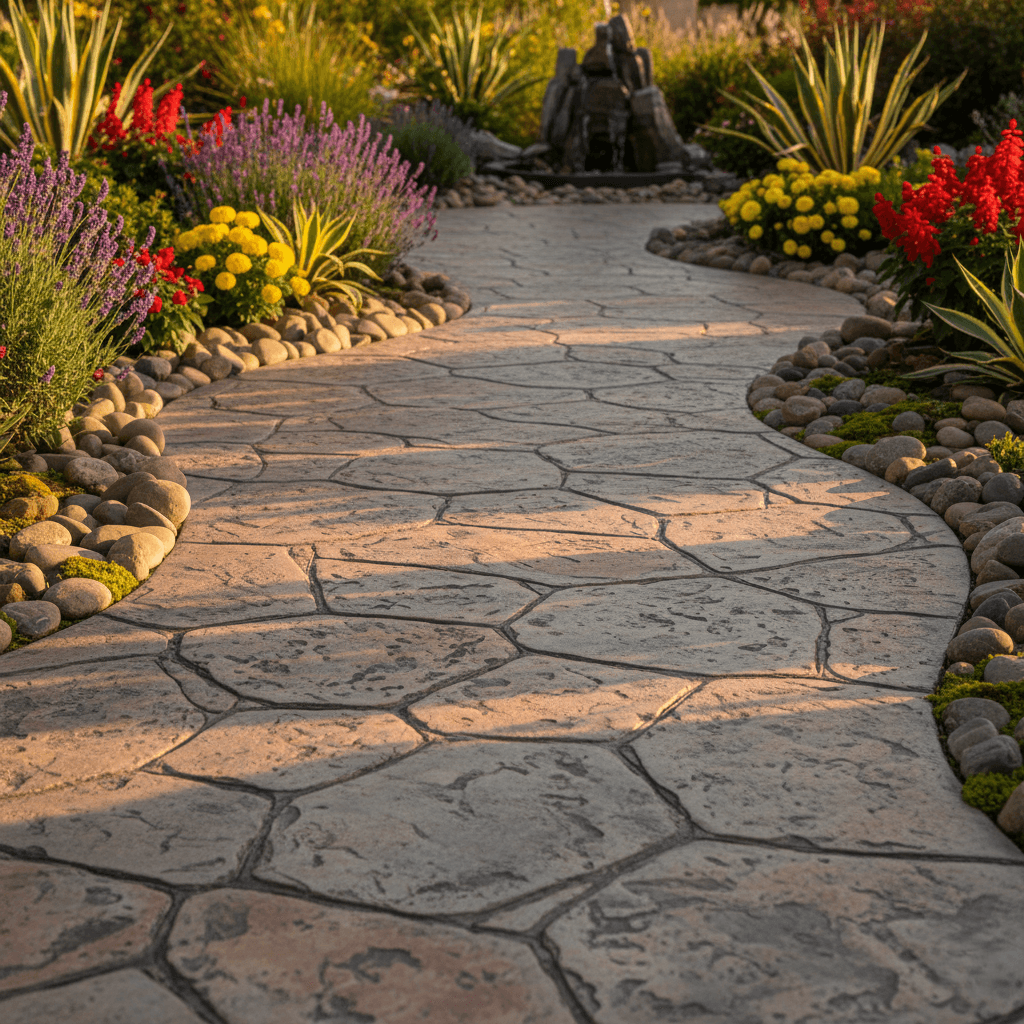
Walkways designed in stamped concrete give a simulated appearance of brick, tile, or natural stone below the cost of all materials. Popular to Pueblo homes are “flagstone,” “cobblestone,” and “slate” colors and textures that harmonize nicely with Southwestern architecture. The imprinting of the pattern in concrete is done before the mixture has cured. A coloring pigment may be ordered in percent in the mix, or it may be applied as a stain to the cured surface. Homes in University Park and Eagleridge often use this type of decoration, and in every case, substantially add to the curb appeal. When properly sealed and maintained, stamped concrete stands up well under Pueblo’s rigorous climate, and the price is pushing only around $12.00 to $18.00 a square foot. Who can complain of such a serviceable substitute for natural stone walk, let alone, from $20.00 to $40.00 a square foot? Exposed aggregate surfaces.
This finish has a sculptured effect that exposes decorative stones in the concrete mix for a beauty to equal the hardest granite. A surface layer of cement is removed before the concrete has had time to cure, revealing colorful pebbles or stones. A vast array of hues and sizes of aggregate is available, so you can select a combination that looks good with your house. The finished surface, having a natural look, is nonslip in rain or ice. This type of finish is an ideal choice for our Pueblo climate; the rough surface retains its “grip” and needs no upkeep. Lots all over Mesa Junction and Northside are enlivened with scenes made beautiful with an exposed aggregate walk. Expect to pay $8 to $15 a square foot for installation, with the cost depending on the aggregate and the difficulty of the layout.
Color and Stains
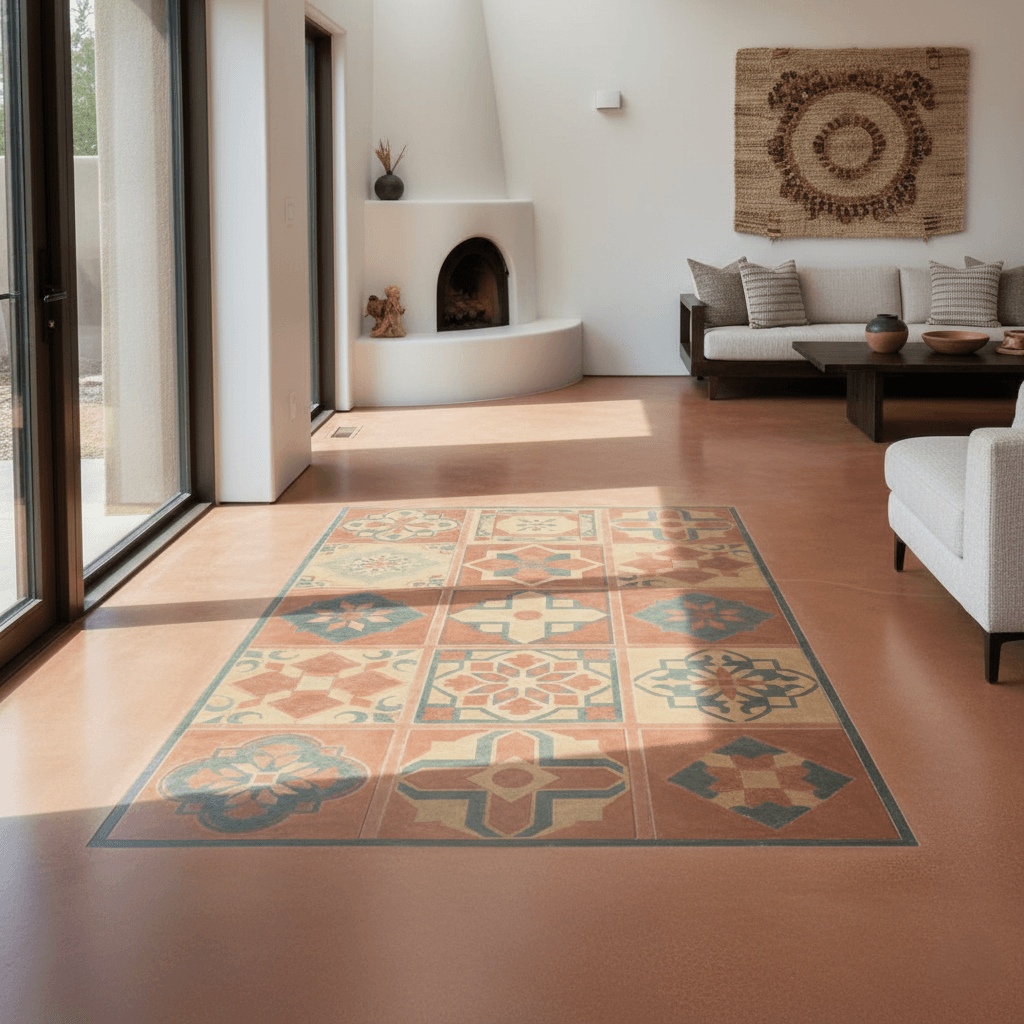
Integral color mixed into concrete as it is being batched will assure consistent layers of fade-proof color. Earth-tone colors, such as tan, terra cotta, and warm gray, blend into the regional coloring of Pueblo beautifully. Note that the color is penetrated to the thickness of the slab, so that if some wear does occur on the surface, the gray concreteunderneath willl not show through. Integral coloring increases the cost of an installation by an additional $1 to $3 a square foot. Acid staining on cured concrete may give a mottled, variegated look; the reaction is not the same every time, so it is not really possible to produce a perfect reproduction of the same effect in the same way every time. You can vary a single color by “simultaneously” layering on more than one color for depth and interest. Walks in Country Club and Heritage nooks are enlivened by such facades. Staining may run from $3 to $7 per square foot, in addition to preparation and sealing.
Layout and Design Patterns
Straight paths versus curved. The clean pathing leads efficiently while simplifying placement, and plantings keep it lower in cost. Curved walkways provide softer transitions through the much harder landscapes. Gentle turns escort visitors through the garden while providing eye appeal and enhancement of the journey to your door.
Properties wherein the street and the home front door are farther apart are ideal candidates for curvilinear designs whose primary purpose is to make the journey seem shorter and more inviting. Pueblo’s southwest California architecture is often complemented by gentle curves as they flow through your xeriscaping. This design decision should flow from your own home architecture and other features of the existing landscaping throughout your property.
Geometric Patterns and Sections
Arranging a walkway in geometric sections breaks up the monotony, serves a practical design purpose, and creates visual interest. Semi-squareness or rectangular sections of three to four feet in size promote controlled movements, since the divisions serve as control joints and help direct the cracking to pre-determined places. You can also make each section different and alternating colors or textures from the previous section may add to them decoratively.
If your current home is of the contemporary sort found in Belmont and Skyview, you may care to make a bold geometric treatment as a device to allow visual numbers make a strong statement. Alternating sections may even be differently finished so as to contrast and encourage the eye down the path as it progresses. The arrangement can also solve the movement problem resulting from temperature changes, which have been detrimental to your Pueblo concrete here.
Border and Edge Treatments
These elements are themselves places where a contrasting-edged border frames the walkway and happens to add definition to the edges. Repeat stamped patterns that vary from the walkway are designer elements, making for contrast when the basic edge of the walkway is of brick or stone, or wrought in differently colored concrete. A wide border of 12 to 18 inches is a considerable visual element. This design feature will cost extra, $3 to $8 per linear foot, depending on gravity, materials, and measurements. Edges should be rounded or otherwise beveled. A corner may chip or crack if it retains sharp 90-degree angles. Most properties in Pueblo benefit from a little love at the edge of their walkways. The custom-designed borders are purposeful and delicate rather than invasive on the overall look of the walkway.
Drainage and Grade
A good slope will carry rainwater away from the building rather than the other direction toward the walks. A two percent grade (one quarter inch per foot) will carry sufficient rain without lending to sore feet. Proper walks should slope away from the home, garage, or other structure. Proper drainage of the soil favors Pueblo’s clay soil and prevents problems in the foundations below.
Properties where the layout presents difficulty may require stepped walks or retaining walls. We will study the drainage of the property and provide any necessary treatment that will protect the walk. Areas like West Park and Sunset are in need of judgment regarding the privacy of the movements of water in accordance with the individuality of topography.
Custom Specifics for Climate
Only 100 freeze-thaw cycles a year in our locality. Air-entrained concrete mixes are widely used for their resistance to thermal stress. The cities with extreme climates have learned much about the microscopic bubbles of air and their application in the city. Vaporized from hot concrete, the microscopic air bubbles furnish a space for the expanding water pushed to its freezing point, thereby avoiding other vulnerable spots and places for water to freeze, scale, and crack. Wienert Cour Labor contends that there are no perfect applicators for the sidewalks in Pueblo other than her edited concern about the conditions. Proper specifications prove necessary in all walks of Edmonton. We specify mixes for all our walks in Pueblo. We don’t care what the treatment is for, decoration or otherwise.
The intense summer sun destroys some hues faster than others. The lighter earth tones seem better able to withstand the ravages of the sun. Sealing was employed to protect colored surfaces from injury from the sun, aside from wind-driven rain damage. Walkways in Pueblo should be resealed every couple of years to remain visually appealing and protected. Whether the sealer is solvent-based or water-based, it is a more economical choice than having to replace the material too soon because it wasn’t correctly specified.
Incorporating Lighting
Lighting is a good safety feature to have in your home, and it can be beautiful after the sun goes down as well. Low-voltage LED walkthrough lights on either side of your walkway are a practical light source that will not blind anyone. Solar lights alleviate the need for remotes, wiring, and paying for electricity, and can be used to pick out a clearly defined path and make a lovely, welcoming entrance when arriving at night. Plan to put in some conduit when the walkway is being installed so that you can add downlights later without major upheaval—the cost is slight, but that convenience is priceless later on. More properties throughout Pueblo are having lighting incorporated right into their walk design, taking full advantage of the practical and the beautiful features.
Landscaping Integration
Walkway design should “talk” to the landscaping already in place or planned. When a planting pocket is created, an easy way to provide living plant materials is to plant low-growing, hardy ornamental grasses or other plants in it that may not grow tall enough to obstruct the main path of travel. This softens the hard design line and helps tie the walkway into its garden neighbors. Of course, Pueblo plants that desire a xeriscape environment do very well in walkways requiring little or no moisture irrigation to survive, and the peeking out ‘tufts’ fit in ‘handsomely’ as well. Make sure there is space given in planting buffers to make room for the plants to grow to their desired dimensions; otherwise, crowded conditions invite rotting plants and concrete failure in the event that roots push to surround the concrete as it dies in bleak wedlock. We show homeowners just how they can plan the designs to work happily with whatever plants are currently in place, or planned with a stronger “green” thumb for later.
Accessibility and Safety Features
Handrails are necessary for any walkway that has steps or a steep slope. Railing height and strength must meet local building codes. Nonslip surfaces have proven vital for Pueblo’s winter when icy and snowy. Textured or aggregate concrete finishes provide better traction than smooth concrete. Adequate width and gradual grade changes allow for wheelchairs, walkers, and the aged homeowner who plans on living in the home for a long time. Universal design principles result in pathways suitable for people of all abilities and prove to be a boon for the multi-generational homes that can be found throughout Pueblo.
Budget and Cost Planning
Basic concrete, undecorated walkways cost $5 to $10 per square foot for a normal installation. Decorative treatments increase that to $12 to $25. A typical 50-foot-long by four-foot-wide walkway totaling 200 square feet would range from a $1,000 basic concrete path through to a $5,000 elaborate stamped and colored design. All are worthwhile investments that improve curb appeal and will give decades of service.
Budgeting should account for both the original installation and the long-term maintenance. Generally, those installations where the contractor has taken the time to specify according to appropriate practice will cost more originally but return the property owner the costs incurred so much quicker, as less maintenance is generally required and the entire installation should last longer. Towns from Aberdeen to West Park are benefiting from the good balance of specifications that are appropriate for the home, with the upfront cost and lifetime investment. We assist in showing homeowners these trade-offs so a reasonable choice can be adopted that is within their budget.
Professional Design Services
Professional design based on received opinion will result in making the most of the walkway. Meeting both aesthetic and functional requirements requires experience from the designer. Features of the lot, styles of home, landscaping, and budget parameters all assist in designer recommendations. My experience of Pueblo soils and climate contributes so much more to the actual details of design. The investment in professional services is worth it, avoiding the potential for poor choices while maximizing design terms.
The benefit of computer-generated visualizations will be seen before work is begun on Pueblo pathways, so the consumer will know in advance what the walk will look like and can make refinements to ensure satisfaction. You will be pleased to know that we specialize in walkways, beautifying your home.
At Pueblo Concrete Services, we work to the needs of your home: We specialize in functional and decorative homemade concrete pathways for Pueblo homes. Our beautiful walks connect your spaces. Each walks out to meet the gorgeous paths of nature at her back door. We balance aesthetics against the technical requirements of the region, gates to your property that should withstand for your use at least forty years.
LATEST POSTS